Peak Buyer Intent After Checkout: Why This Exact Moment Is Your Revenue Booster
"In other words, the post-checkout moment is the point of peak buyer intent, and savvy merchants capitalize on it."
Key Takeaways
- Post-Purchase Upsell means: You make a relevant add-on offer after payment - the order is secure, the upsell is bonus.
- Because the customer just said "Yes", buying resistance is at its lowest - more add-ons, higher AOV, more profit.
- The fastest business case: 3x ROI can be calculated with just 5 numbers (see ROI-Calculator).
- Critical: 1 offer, super relevant, frictionless (payment/order), clean legal framework.
The customer is in buying mode - but no longer in doubt mode.
The psychological foundation of the post-purchase moment
Why Post-Purchase Upsells Are Essential Right Now for eCommerce Merchants
Post-Purchase Upsell means: Right after successful payment, you show a specific, matching add-on - with minimal friction (ideally: One-Click). This is not "nice to have" but a strategic revenue lever, because you optimize at the point where performance marketing is most expensive today: you extract more value from a customer you already paid to acquire.
The psychological core is simple: After the purchase, the decision is already made. The customer has committed, trust is established, and the "transaction problem" (payment/address) is solved. That is exactly why the moment after checkout is so powerful: the customer is in buying mode - but no longer in doubt mode. This creates a window where an add-on does not feel like a pushy sales trick, but like a helpful addition: "Oh right, I need that too."
Concrete example (realistic parameters): You sell sneakers. Right after the purchase, you offer a care kit for 14.90 Euro. It is logical, cheap enough for an impulse buy, and immediately increases the value of the main product. Result: even with moderate acceptance, this makes real impact on a monthly basis (calculator follows).
Error
You place the add-on in the cart - users compare, hesitate, abandon.
Solution
Add-on after checkout - you do not lose buyers, you gain additional purchases.
Post-Purchase is slightly more "technical" than an email campaign. But: This technical hurdle is exactly your advantage, because it gives you a lever that many shops do not consistently use.
The Quick Reality Check: What Happens If You Offer Nothing?
The order confirmation is a dead end in many shops: "Thank you for your purchase." Period. That is like turning off the lights at a store right after the checkout - even though the customer just had their credit card in hand.
Because the buyer lands on the Confirmation Page anyway, this is your free touchpoint with 100% reach among buyers. If you offer nothing there, this happens:
- You leave accessory revenue to Amazon or later price comparisons.
- You shift cross-sell entirely to email - and lose impulse & context.
- You artificially suppress your AOV and have to compensate in marketing with expensive traffic.
Concrete trade-off (CMO-relevant): If CAC rises and AOV stays the same, contribution margin per new customer drops. Post-Purchase is a lever that counters this directly, because every additional Euro of AOV directly improves your CAC headroom.
The Double Opt-In Problem
Email also has the double opt-in hurdle. Many customers never receive marketing emails because they do not complete the process. The post-purchase moment on the page reaches 100% of buyers - immediately, without consent barriers. This is a massive argument.
100% Reach
Every single customer who buys from you sees the upsell offer. No filters, no opt-ins, no delayed emails. The buying energy is used immediately.
Comparison Matrix: Why Post-Purchase Is Often the Smartest Upsell
Post-Purchase vs. Cart Upsell vs. Email
| Feature/Scenario | Post-Purchase | Cart | Causal Explanation (The "Why") | |
|---|---|---|---|---|
| Risk for Checkout Conversion | Minimal | High | None | Because payment is complete, the upsell cannot prevent the primary purchase. |
| Revenue Potential per Customer | High | Medium | Low | Because buyers have less resistance after saying "Yes", willingness for add-ons increases. |
| Speed-to-Value | Fast | Fast | Slow | Because you do not wait for email opens, additional sales happen immediately in the same purchase moment. |
| Operational Impact | Well manageable | Well manageable | Complex | Because an add-on often ships with the same delivery, additional costs drop compared to separate orders. |
| Alternative: Email After-Sales | - | - | Easy, but slower | Because buying energy cools down later, impulse conversion drops - but setup is easier. |
Risk for Checkout Conversion
Because payment is complete, the upsell cannot prevent the primary purchase.
Revenue Potential per Customer
Because buyers have less resistance after saying "Yes", willingness for add-ons increases.
Speed-to-Value
Because you do not wait for email opens, additional sales happen immediately in the same purchase moment.
Operational Impact
Because an add-on often ships with the same delivery, additional costs drop compared to separate orders.
Alternative: Email After-Sales
Because buying energy cools down later, impulse conversion drops - but setup is easier.
The Profit Boost in Detail: Calculate Your 3x ROI in 2 Minutes
If you want CMOs to say "I absolutely need this" at the end, you need a calculation that feels good immediately - without Excel monsters.
The assumed take rate of 5% is statistically below the average of 5.6% reported by Shopify solution providers.
Upsells/Month
500
Additional Revenue
9.500 €
Additional Profit
4.150 €
Max. Monthly Fee for 3x ROI
1.383 €
Why this is so convincing: Because it is not "maybe someday". The effect happens in the same purchase moment. You do not buy additional clicks. You monetize buyers who have already purchased.
Use Cases That Almost Always Work (incl. Numbers, Errors, Trade-offs)
Proven upsell strategies with concrete examples
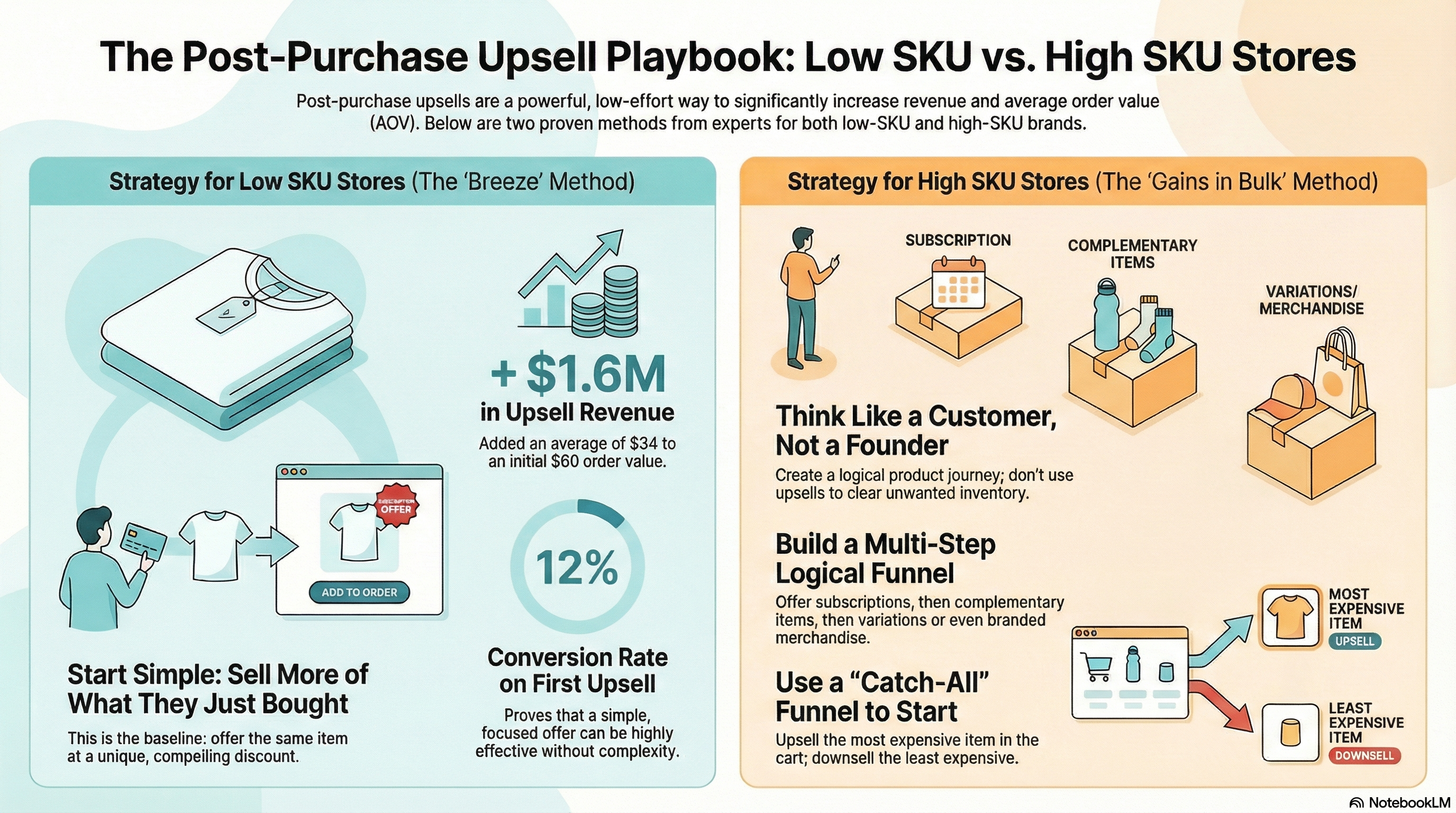
"Complete the Set" - the Perfect Accessory
Because customers just bought Product A, demand for Product B arises that improves usage. This makes the upsell feel like service, not advertising.
Beispiel
Coffee Machine - Descaler/Filter Pack 12.90 Euro
Error case: 5 accessories at once - decision paralysis.
Solution: 1 bundle ("Starter Kit"), clear benefit, one click.
Refill & Consumables - Predictable, Recurring, High-Margin
Because consumables are guaranteed to be needed, relevance is maximum, which lifts take rate and CLV.
Beispiel
Razor - Blade Pack 24.90 Euro
Trade-off: Too-early refill offer can feel "too pushy".
Solution: "So you are covered for the next 6 weeks..." + optional small discount.
Protection & Security - "Risk Reduction" Sells Easily
Because customers want to protect expensive products, protection offers convert well when simply explained.
Beispiel
Smartphone - Screen Protector + Case Bundle 17.90 Euro
Trade-off: Legal/info requirements (depending on product type) must be clean.
Solution: Clear service description, correct pricing, no fine print surprises.
Fashion: "Complete the Look" Without Cart Chaos
Fashion is perfect for post-purchase upsells because the primary purchase is already emotionally "won": The customer chose an outfit piece, the style is set - and exactly at this moment, matching add-ons are not advertising but a quick style shortcut.
Beispiel
Belt for jeans, socks for shoes, care products (waterproofing), jewelry/accessories, cap/beanie, tote bag
What works: "Finishers" not "Alternatives" - Post-purchase is ideal for "this completes it", less for "try this other dress".
Solution: A curated "Look Upgrade" bundle feels like service, not upselling.
Tech Without Headaches: How to Keep It Clean (and Scalable)
A post-purchase upsell only feels "magical" when it is frictionless. Three things decide:
Payment Flow
One-Click means: No checkout form again - payment happens via existing session (e.g., PayPal Vaulting).
Order Handling
The add-on should - if possible - be added to the existing order so fulfillment does not explode.
Concrete Error Case + Solution: Tax/Shipping Logic Makes Upsell "More Expensive Than Expected"
The upsell is added to the order afterwards, but shipping logic jumps (e.g., free shipping threshold is recalculated or bulky/express triggers). Customer suddenly sees additional shipping costs or a higher total than expected - more abandonment in upsell step, more support ("Why does it cost more now?").
Solution:
- Only show upsells that do not change shipping type (no bulky goods, no other zones).
- Shipping rule: "Upsell added - shipping stays like main order" (or include shipping costs in upsell price).
- Clearly communicate in upsell: "No additional shipping costs - ships together."
No New Consent Required
Since the upsell is part of the existing purchase process, no separate marketing consent is needed.
Gray Zones: When Alternatives Are Better - and Why Post-Purchase Still Wins
Unlike cart upsells, post-purchase is superior when you want to protect conversion. Email after-sales is better when you need more explanation or when the add-on cannot be decided immediately.
High-Priced Products
For upsells over 100 Euro, take rate drops. Here email with detailed consultation may work better.
Complex Advisory Products
Products that need explanation are less suitable for one-click upsells.
Nevertheless, post-purchase remains the stronger lever for most B2C shops because it works exactly where buying energy is highest - immediately after the "Yes". The ideal is often the combination: Post-purchase for the one "no-brainer" add-on, email for more complex follow-up offers.
FAQ (6 Questions, Direct Answers)
Post-purchase kicks in after the purchase, so the risk of customers hesitating and abandoning due to additional offers drops. Because payment is already complete, checkout conversion stays stable. At the same time, the customer is still in buying mode, which increases willingness for a matching add-on. This combination - high buying energy plus no conversion risk - is the main reason why post-purchase is the most profitable upsell slot for many shops.
For a CMO-ready calculation, orders/month, take rate, upsell price, upsell margin, and rough additional costs (payment/fulfillment/returns) are enough. From these you calculate additional revenue and additional profit. Critical is to calculate on profit, because profit determines CAC headroom and scalability. Additionally you should measure: upsell conversion, incremental AOV, refund rate, support tickets, and fulfillment extra costs.
A good starting point is an upsell price of about 10-30% of AOV or a clear bundle with noticeable benefit. Too high prices lower take rate, too low prices deliver little profit per acceptance. The optimal point depends on margin and relevance. That is why the best approach is: start with a "no-brainer" add-on, measure, then iterate on price/bundling. Important is that the customer understands the benefit in one sentence.
The most common reasons are lack of relevance, too many options, and too much friction in the flow. If the offer does not clearly fit the main product, acceptance drops. If multiple products are offered, decision paralysis occurs. If the user has to enter payment data again or the page is slow, conversion drops.
Start with a single, strongly matching add-on per bestseller category and prioritize products that can ship without a separate package. Define clear rules: only show when stock > X, only one offer per order, clear price/tax logic, clean refund processes. Measure weekly: take rate, incremental profit, and support/returns. Once that runs stable, scale gradually to more categories - instead of building everything at once.
Currently, UpsellMore is optimized for PayPal. Additional providers are in development.
Ready to Boost Your Revenue?
See in a free demo how UpsellMore increases your AOV after checkout.
Request Free Demo